
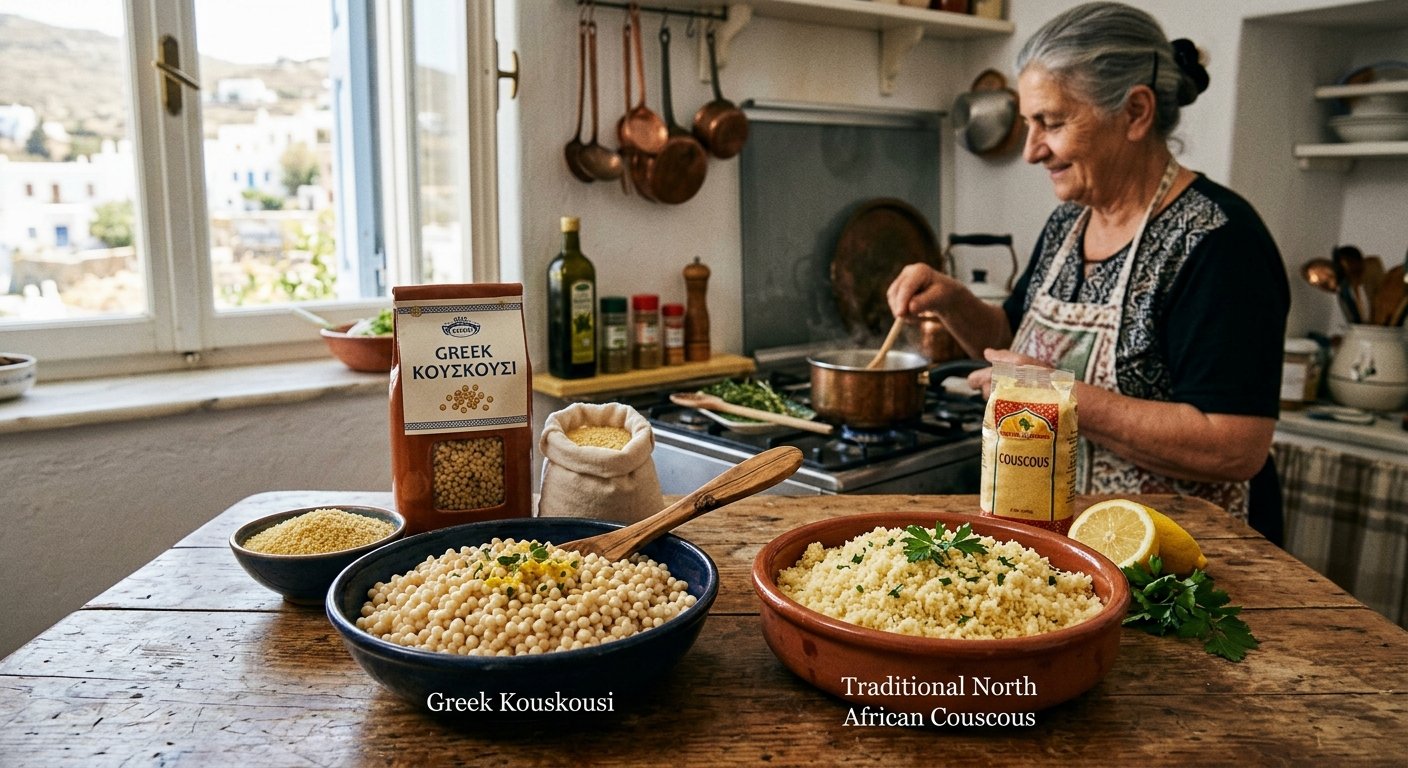
If you’ve searched for kouskousi, you’ve probably noticed that the word does not have one completely consistent meaning online. In some contexts, it refers to couscous, the traditional North African semolina food; in Greek cooking, kouskousi can also refer to a small pasta, particularly associated with regional cuisine. The distinction matters because the two products can look similar but require different cooking methods. This guide explains the terminology, origins, ingredients, cooking techniques, nutritional considerations, and practical ways to use kouskousi without relying on conflicting internet definitions.
Quick Answer: Kouskousi is a regional culinary term that can refer to different small wheat-based foods depending on context. In Greek cuisine, it can mean a tiny pasta used in soups, stews, and other dishes. In other sources, the spelling is used in connection with North African couscous. Always check the product’s ingredients and cooking instructions before preparing it.
What Is Kouskousi?
The first thing to understand about kouskousi is that the spelling alone does not always identify one standardized food.
In Greek culinary writing, kouskousi can describe a small pasta, with examples appearing in recipes from Greek regional cooking. Food writer Diane Kochilas, for instance, uses Greek kouskousi as a tiny pasta alongside lentils, vegetables, and other ingredients.
At the same time, many websites use “kouskousi” as an alternative spelling for couscous, the semolina-based food strongly associated with North African cuisine.
That creates an important SEO and culinary distinction: someone searching for kouskousi may be looking for either product.
Why the name causes confusion
Both foods can appear as small, pale pieces of wheat-based food. Their names are also similar, which makes it easy for online articles to merge the two.
But appearance is not enough to determine how a product should be cooked.
-
Greek kouskousi: may function as a small pasta and generally be boiled or cooked in a liquid.
-
Traditional North African couscous: is made from semolina granules and traditionally prepared through steaming.
-
Commercial products: may be pre-cooked, dried, or processed differently, so the package directions matter.
This distinction is especially useful when buying an unfamiliar product.
Kouskousi vs. Couscous: What’s the Difference?
| Feature | Greek kouskousi | Traditional North African couscous |
|---|---|---|
| Typical form | Small pasta pieces or beads | Small semolina granules |
| Culinary context | Greek/regional pasta dishes | North African cuisine |
| Common cooking method | Boiled or cooked in liquid | Traditionally steamed |
| Main ingredient | Wheat flour and/or semolina, depending on product | Durum-wheat semolina |
| Typical uses | Soups, stews, legumes, vegetable dishes | Served with vegetables, meat, seafood, sauces and stews |
| Texture | Tender, sometimes slightly chewy | Light and fluffy when properly steamed |
| Terminology | Regional and product-dependent | Commonly called couscous in English |
The distinction is not merely academic. If you mistake a small Greek pasta for instant couscous, you could use the wrong amount of water and the wrong cooking technique.
The safest approach is simple: identify the product first, then follow its instructions.
Where Does Kouskousi Come From?
There is no single origin story that can accurately be applied to every food sold or described as kouskousi.
The Greek pasta tradition
Greek kouskousi is associated with regional Greek cooking, including traditions in northern Greece and Thrace. In this context, it is treated as a small pasta rather than as the steamed North African food.
Its practical qualities make sense in traditional home cooking. Small dried pasta can be stored, added to soups or stews, and combined with inexpensive ingredients such as legumes and vegetables.
A good example is Kochilas’s Greek recipe using kouskousi with lentils, cumin, prunes, and other ingredients. The recipe explicitly describes kouskousi as a tiny Greek pasta.
The North African couscous tradition
Couscous has a much broader and well-documented cultural history across North Africa.
UNESCO inscribed the knowledge, know-how and practices related to the production and consumption of couscous on its Representative List of the Intangible Cultural Heritage of Humanity in 2020. The inscription recognizes traditions shared by communities in Algeria, Mauritania, Morocco, and Tunisia.
UNESCO describes traditional preparation as involving semolina that is rolled by hand, steamed, and cooked, along with specialized tools and practices passed between generations. The food is also associated with sharing, hospitality, conviviality, and community.
That cultural context is important. Couscous is not simply a convenient grain substitute; it is part of a living culinary tradition.
What Is Kouskousi Made From?
The ingredients depend on which product the term refers to.
Greek kouskousi
Greek-style kouskousi can be made from wheat flour or semolina, with recipes and commercial products varying. Some traditional versions may include ingredients such as milk or eggs.
This means you should not assume that every package labeled kouskousi has the same ingredients.
North African couscous
Traditional couscous is based on semolina, generally derived from durum wheat. The semolina is moistened and formed into small granules before being steamed.
Modern commercial couscous is often pre-steamed and dried, which is why it can be prepared much faster than traditionally made couscous.
How to Cook Kouskousi
The correct method depends on what your package actually contains.
Method 1: Cooking Greek kouskousi as pasta
If your product is a Greek small pasta, treat it more like pasta than instant couscous.
-
Bring salted water or broth to a boil.
-
Add the kouskousi.
-
Stir occasionally so the small pieces do not settle and stick.
-
Cook according to the package instructions.
-
Taste near the end of cooking.
-
Drain if you are serving it separately.
-
Combine it with sauce, vegetables, legumes, meat, or soup.
Cooking directly in broth can add considerably more flavor than using plain water.
For soup, you can often add the pasta directly to the simmering liquid. Watch the pot carefully because small pasta can continue absorbing liquid after it becomes tender.
Method 2: Preparing instant couscous
If the product is actually pre-steamed couscous, the preparation is different.
-
Bring the recommended amount of water or broth to a boil.
-
Add salt and, if desired, a little olive oil.
-
Add the couscous according to the package instructions.
-
Cover and allow it to absorb the liquid.
-
Rest for the recommended time.
-
Fluff gently with a fork.
Do not automatically use a fixed water-to-couscous ratio for every brand. Product size and processing can affect the amount of liquid required.
Method 3: Traditional steaming
Traditional couscous preparation is considerably more involved.
UNESCO describes a process in which semolina is rolled into grains, steamed, and cooked using specialized utensils. The couscous is traditionally prepared alongside or above a stew, allowing steam to pass through the grains.
This method takes longer than preparing instant couscous, but it is part of the culinary practice and texture associated with traditional couscous.
How to Get the Best Texture
Whether you’re working with Greek kouskousi or couscous, moisture control is crucial.
Avoid too much liquid
Excess liquid can turn small wheat products soft and heavy. Start with the manufacturer’s recommended quantity rather than assuming every product behaves identically.
Don’t overcook it
Small pasta cooks relatively quickly. Begin tasting before the maximum cooking time is reached.
Use flavorful liquid
Water works, but broth can make a dramatic difference.
Try:
-
Vegetable stock for vegetarian dishes
-
Chicken stock for poultry-based meals
-
A richly seasoned stew for traditional-style preparations
-
Tomato-based broth for a Mediterranean-inspired dish
Fluff gently
For couscous, a fork is useful for separating the grains without compressing them.
For Greek kouskousi, gentle stirring during cooking helps prevent sticking while preserving the pasta’s texture.
What Does Kouskousi Taste Like?
Kouskousi generally has a mild wheat flavor, which is one reason it works so well with strongly seasoned foods.
The ingredient itself does not need to dominate the dish. Instead, it can absorb flavors from:
-
Olive oil
-
Lemon
-
Garlic
-
Herbs
-
Broth
-
Tomato
-
Roasted vegetables
-
Chickpeas and lentils
-
Chicken or lamb
-
Seafood
-
Spices
Greek kouskousi can have a pasta-like bite, while traditionally prepared couscous is prized for a lighter, fluffy texture.
The exact experience depends heavily on the product and cooking method.
What Goes Well With Kouskousi?
Because the flavor is relatively neutral, kouskousi is extremely flexible.
For a quick weeknight meal
Combine cooked kouskousi with:
-
Chickpeas
-
Roasted zucchini
-
Bell peppers
-
Cherry tomatoes
-
Parsley
-
Lemon
-
Olive oil
This produces a simple Mediterranean-style bowl without requiring complicated cooking.
For a hearty meal
Use kouskousi with:
-
Chicken
-
Lamb
-
Beans
-
Lentils
-
Root vegetables
-
Tomato-based sauces
-
Rich broth
For a lighter salad
Cook the pasta or couscous, cool it, then add cucumber, tomato, parsley, mint, lemon juice, olive oil, and a little feta if appropriate for the specific recipe.
The key is not to drown the small pasta in dressing. Its mild flavor works best when the other ingredients remain balanced.
Is Kouskousi Healthy?
“Kouskousi” is too broad a term to assign one universal nutrition profile.
If you’re buying a packaged product, check the nutrition label and ingredient list. Refined wheat products generally provide carbohydrates and some protein, while whole-grain versions can provide more fiber.
More importantly, consider the whole meal.
Kouskousi paired with vegetables, chickpeas, lentils, lean protein, herbs, and healthy fats can form a balanced meal. A bowl dominated by a large portion of refined wheat pasta and a rich sauce will have a very different nutritional profile.
So rather than asking whether kouskousi is automatically “healthy,” consider:
-
What type of kouskousi is it?
-
What portion are you eating?
-
Is it whole grain or refined?
-
What foods are served with it?
-
How much added fat or salt is in the preparation?
Is Kouskousi Gluten-Free?
Traditional wheat-based kouskousi and couscous are not gluten-free.
They are generally made from wheat, including durum-wheat semolina. Anyone who needs to avoid gluten should therefore check the package carefully.
Do not assume that a product is gluten-free simply because it looks like rice or another naturally gluten-free grain.
Gluten-free couscous-style products do exist, but they are alternatives rather than traditional wheat couscous. If avoiding gluten for medical reasons, look for an explicit gluten-free label and check for possible cross-contact warnings.
Common Mistakes When Cooking Kouskousi
Treating every product the same
This is the biggest mistake.
A Greek small pasta, traditional couscous, and instant couscous can require completely different preparation.
Using too much water
Extra liquid does not necessarily produce softer, better kouskousi. It can create a soggy texture.
Ignoring the package instructions
Commercial products vary. The instructions printed by the manufacturer are usually more reliable than a generic recipe found online.
Overcooking small pasta
Because the pieces are tiny, they can go from pleasantly tender to mushy faster than larger pasta shapes.
Under-seasoning
Kouskousi has a mild flavor. Salt, broth, herbs, spices, lemon, garlic, or olive oil can help bring the dish to life.
How to Store Cooked Kouskousi
If you have leftovers, cool them appropriately and refrigerate them in a clean, covered container.
When reheating, a small splash of water or broth can restore moisture. Warm the food gently rather than exposing it to excessive heat for a long period.
For meal preparation, kouskousi can be useful because it pairs with different ingredients throughout the week. One batch can become a salad one day and a vegetable-and-chicken bowl the next.
Frequently Asked Questions
What is kouskousi?
Kouskousi is a regional culinary term whose meaning depends on context. In Greek cuisine, it can refer to a small pasta used in dishes such as soups, stews, and legume-based meals. Some sources also use the term in connection with North African couscous.
Is kouskousi the same as couscous?
Not necessarily. The terminology overlaps, but Greek kouskousi can refer to a small pasta that is cooked more like pasta, while traditional North African couscous is made from semolina granules and traditionally steamed. The product’s ingredients and cooking directions are the best guide.
How do you cook kouskousi?
If it is Greek kouskousi pasta, it is generally cooked in boiling water, stock, soup, or another liquid. If the product is instant couscous, it is usually rehydrated with hot water or broth. Always follow the specific package instructions.
Is kouskousi gluten-free?
Traditional wheat-based kouskousi is not gluten-free. It commonly contains wheat or durum-wheat semolina. Anyone avoiding gluten should choose a product specifically labeled gluten-free.
What do you eat with kouskousi?
Kouskousi pairs well with vegetables, chickpeas, lentils, herbs, lemon, olive oil, chicken, lamb, seafood, tomato sauces, and flavorful broths. The best pairing depends on whether you’re using Greek kouskousi or North African-style couscous.
Final Takeaway
The most useful thing to know about kouskousi is that the word requires context. It can describe a small Greek pasta in regional culinary usage, while some English-language sources use it as a spelling associated with couscous. Treating the terms as automatically interchangeable can lead to incorrect cooking instructions.
For the best results, identify the product, read its ingredient list, and follow its cooking directions. Once you know which version you have, kouskousi becomes an exceptionally versatile ingredient for soups, salads, stews, vegetable dishes, and complete meals.
