
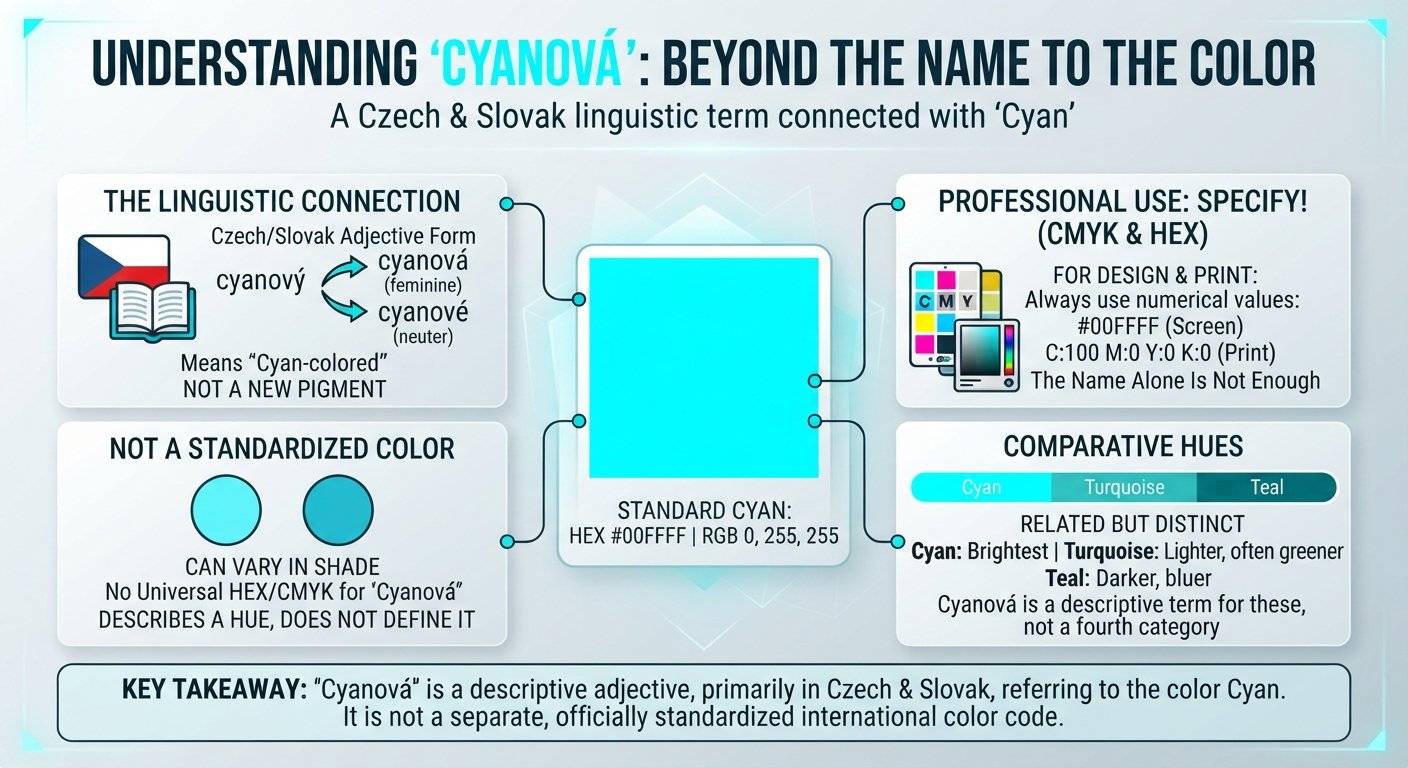
If you have come across the word cyanová, you may wonder whether it is a new color, a design trend, or simply another name for cyan. The simplest explanation is that cyanová is primarily a color-related expression connected with cyan, the familiar blue-green color. In Czech and Slovak usage, the word can mean “cyan-colored,” rather than identifying a completely separate standardized color. Understanding that distinction makes the term much easier to interpret in design, digital graphics, printing, fashion, and everyday language.
Quick Answer: Cyanová is primarily connected with the color cyan and is especially associated with Czech and Slovak linguistic usage. It should not automatically be treated as a separate internationally standardized color with its own universal HEX, RGB, CMYK, or Pantone value.
What Does Cyanová Mean?
At its simplest, cyanová means cyan-colored.
The word is closely connected to Czech and Slovak language usage, where adjectives can change their form according to the grammatical characteristics of the noun they describe. This helps explain the distinctive “-ová” ending.
For someone encountering the term in English, however, the spelling can make it look like something completely different. It might initially appear to be:
- A newly invented color
- A fashion or beauty brand
- A person’s surname
- A digital design trend
- A particular shade of turquoise
- A creative aesthetic
In the strongest documented interpretation, however, its meaning is much simpler: it describes something associated with cyan or having a cyan color.
Is Cyanová a Separate Color?
This is where the terminology becomes important.
Cyanová is a genuine color-related word, but it is not established as a separate internationally standardized color in the same way as cyan.
Cyan itself has well-defined technical uses in digital color and commercial printing. By contrast, there is no single universally accepted specification that says every color called “cyanová” must use one particular HEX, RGB, CMYK, Pantone, or RAL value.
That means two designers could potentially use the label cyanová while selecting slightly different blue-green shades.
One might choose a vivid electric cyan.
Another might select a softer cyan that leans slightly toward turquoise.
Both could use the word descriptively, but the actual colors would not necessarily be identical.
Why the distinction matters
Suppose a client tells a designer:
“Make the logo cyanová.”
That instruction is not precise enough for professional color reproduction.
The designer should ask for an exact color reference, such as:
- HEX value
- RGB values
- CMYK values
- Pantone reference
- Approved physical color sample
The name provides a general visual direction. A numerical specification provides precision.
Cyanová and Standard Cyan
The easiest way to understand cyanová is to start with cyan itself.
Cyan is a blue-green color that sits visually between blue and green. It has an important role in both digital graphics and printing.
For example, the W3C’s CSS color specification defines the named color cyan as:
HEX: #00FFFF
RGB: 0, 255, 255
CSS also treats aqua as equivalent to this value.
However, this does not mean that #00FFFF is the official universal code for every color someone might call cyanová.
That is an important SEO and design distinction.
A web article can use the standard cyan value as a useful reference, but it should not claim that every interpretation of cyanová automatically equals #00FFFF.
Why Cyanová Does Not Have One Universal Color Code
Color names and color specifications serve different purposes.
A descriptive name communicates an approximate visual idea.
A numerical color value identifies a specific color within a particular color system.
Consider the word blue.
Blue could describe:
- Navy
- Sky blue
- Royal blue
- Powder blue
- Electric blue
The same principle applies to cyan-related terminology.
A designer might use a bright cyan-like color when creating a digital interface, while an interior designer might choose a muted blue-green paint.
Calling both colors cyan-related does not make their numerical values identical.
This is why professional projects should specify the actual color rather than relying solely on the name cyanová.
The Linguistic Connection Behind Cyanová
The unusual spelling is one reason people search for the term.
Cyanová is strongly associated with Czech and Slovak usage. In these languages, adjectives can change form depending on the noun they modify.
For English speakers, this can be easy to misunderstand.
The “-ová” ending should not automatically be interpreted as evidence that somebody invented a new color.
Instead, it can reflect the grammatical structure of the language.
For example, a phrase using cyanová may simply communicate the idea of something being cyan-colored.
This linguistic explanation is one of the most useful ways to understand why the term looks different from the familiar English word cyan.
What Does Cyan Look Like?
Cyan belongs to the blue-green part of the visible color spectrum.
A useful mental image is a mixture of strong blue and green visual qualities.
Depending on the exact shade, cyan can remind people of:
- Clear tropical water
- Bright swimming pools
- Glowing digital interfaces
- Blue-green glass
- Certain mineral surfaces
- Bright photographic highlights
Pure digital cyan is particularly vivid because it combines maximum red-channel absence with strong green and blue components in the RGB model.
But real-world cyan-related colors can appear considerably softer.
Lighting, materials, displays, pigments, and surrounding colors can all influence how a shade is perceived.
Cyanová vs. Turquoise vs. Teal
One of the most common sources of confusion is the difference between cyan, turquoise, and teal.
These colors are related, but they are not interchangeable technical terms.
| Color | General Appearance | Common Context |
|---|---|---|
| Cyan | Bright blue-green | Digital graphics, printing |
| Turquoise | Blue-green with a softer, often lighter appearance | Fashion, jewelry, interiors |
| Teal | Darker, more subdued blue-green | Branding, interiors, clothing |
| Cyanová | Cyan-related descriptive term | Linguistic and creative contexts |
The important point is that cyanová should not automatically be treated as a fourth standardized color sitting beside cyan, turquoise, and teal.
Its meaning is more dependent on linguistic or contextual usage.
How Cyanová Is Used in Digital Design
Cyan and cyan-like colors are popular in digital interfaces because they can create a bright, energetic appearance.
You may see cyan-related colors in:
- Website buttons
- App interfaces
- Technology branding
- Gaming graphics
- Data visualizations
- Digital illustrations
- Neon-style artwork
- Futuristic interface concepts
Bright cyan can attract attention quickly, making it useful for accents.
However, using a highly saturated cyan everywhere can make a design visually tiring.
A better approach is often to use it selectively.
Example
Imagine a technology website with a dark background.
Instead of making every heading cyan, a designer might use:
- Dark background
- Light neutral text
- Cyan accent buttons
- Cyan icons
- Subtle cyan gradients
The result gives cyan a clear visual role without overwhelming the page.
Cyanová in Printing
Cyan is especially important in professional printing because it is one of the four process colors in the CMYK system:
- Cyan
- Magenta
- Yellow
- Key/black
This means cyan has a technical function beyond simply being a color people like visually.
However, printing cyan is not exactly the same as displaying cyan on a monitor.
A screen produces color through emitted light.
A printer produces color through inks placed onto a physical surface.
Consequently, a shade that looks extremely bright on a modern display may appear different when printed.
For accurate printing
If a project uses a cyanová-inspired palette, check:
- The intended color value
- The CMYK conversion
- The printer’s color profile
- The paper type
- A physical proof when color accuracy matters
This is much more reliable than sending a printer only the word “cyanová.”
Using Cyanová in Branding
Cyan-related colors can work particularly well for brands associated with:
- Technology
- Innovation
- Digital services
- Water
- Cleanliness
- Energy
- Creativity
- Modern design
But color psychology should not be treated as an exact science.
The meaning of a color changes according to culture, context, saturation, surrounding colors, typography, and the overall brand identity.
A vivid cyan logo may communicate energy and modernity.
A muted cyan can feel calmer and more sophisticated.
The same basic hue can therefore produce very different branding results.
Cyanová in Fashion and Interiors
Cyan-inspired shades can also be used outside digital design.
Fashion
A bright cyan garment can act as a strong statement piece.
For a less intense appearance, designers can combine cyan-related shades with:
- White
- Gray
- Black
- Navy
- Soft neutrals
Interior design
Pure digital cyan is usually extremely intense for large surfaces.
For walls or furniture, softer blue-green variations are generally easier to incorporate into a room.
Cyan-related accents can work particularly well in:
- Bathrooms
- Coastal interiors
- Children’s spaces
- Modern offices
- Creative studios
- Accent walls
Again, the actual color should be selected from a physical or digital sample rather than from the word alone.
Why Cyanová Is Appearing in Online Searches
The term has received increased attention across English-language websites during 2026, particularly in articles discussing color meanings, design, and digital aesthetics.
That increased visibility can make the word seem newer than it actually is.
There is an important difference between a term becoming popular in English-language search results and a new color being officially created.
Current sources do not establish cyanová as a newly standardized international color.
Instead, the safer interpretation is that the term is receiving renewed online attention while remaining closely connected to the established concept of cyan.
Practical Tips for Choosing a Cyanová-Like Shade
If you are using the term for a creative project, follow these steps.
1. Define the purpose
Is the color for a website, logo, print publication, clothing item, or room?
The answer affects the appropriate color system.
2. Choose a specific shade
Do not stop at “cyanová.”
Select an actual swatch.
3. Record the color value
For digital work, record the HEX and RGB values.
For print, establish the appropriate CMYK or spot-color specification.
4. Test it in context
A color can look different beside black than it does beside white.
5. Check accessibility
Text and interface elements need sufficient contrast.
A beautiful cyan accent is not useful if users cannot comfortably read the text placed over it.
6. Test the final medium
A screen preview cannot perfectly predict every printed result.
Common Misconceptions About Cyanová
“Cyanová has one official HEX code.”
There is no broadly established universal Cyanová HEX value. #00FFFF is the standard CSS value for cyan, not proof of a separate Cyanová specification.
“Cyanová is completely different from cyan.”
The strongest available interpretation connects the term directly with cyan rather than establishing an entirely separate color.
“Cyanová is the same as turquoise.”
Not necessarily. Cyan, turquoise, and teal are related blue-green colors, but they can have noticeably different visual and technical characteristics.
“The name alone is enough for professional color matching.”
It is not. Professional reproduction requires an exact color specification or physical reference.
FAQ About Cyanová
What does cyanová mean?
Cyanová is primarily a color-related expression connected with cyan. It is particularly associated with Czech and Slovak linguistic usage, where it can mean “cyan-colored.”
Is cyanová a real color?
It is a genuine color-related term, but it should not automatically be considered a separate internationally standardized color. The established technical color is cyan.
Is cyanová the same as cyan?
In its strongest linguistic interpretation, cyanová describes something that is cyan-colored. However, the term does not establish one universal technical shade, so context still matters.
What is the HEX code for cyanová?
There is no universally accepted HEX code specifically for cyanová. Standard digital cyan is represented in CSS as #00FFFF, with RGB values of 0, 255, 255.
What is the difference between cyan, turquoise, and teal?
Cyan is generally a bright blue-green color with important digital and printing applications. Turquoise and teal are related blue-green colors, but they typically differ in hue, saturation, and darkness. Cyanová is better understood as a cyan-related descriptive term rather than another standardized color category.
Conclusion
Cyanová may look like the name of a mysterious new color, but its meaning is much easier to understand once its linguistic connection to cyan is recognized. It is primarily associated with Czech and Slovak usage and can describe something as cyan-colored.
The key distinction is between a color name and a technical color specification. Cyan has established roles in digital color and CMYK printing, while cyanová does not have one universally accepted HEX, RGB, CMYK, Pantone, or RAL value.
If you plan to use a cyanová-inspired shade in a professional project, choose the exact color first, record its technical value, test it in its intended medium, and check accessibility where relevant.
