
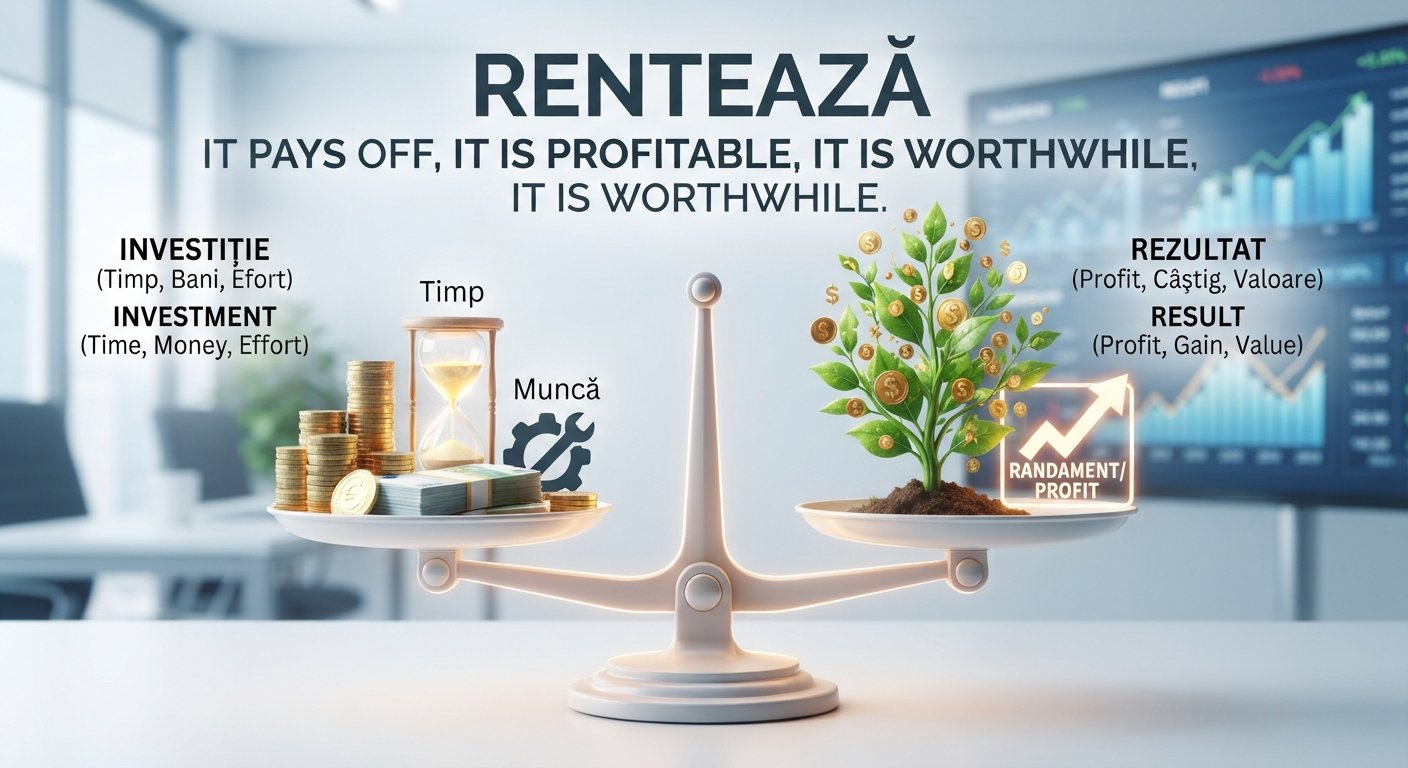
If you have searched for renteaza, you are most likely looking for the meaning of a Romanian word. The standard spelling is rentează, and it comes from the verb a renta. Depending on the context, it can mean “it is profitable,” “it pays off,” “it is worthwhile,” or “it is worth the effort.” Romanian dictionary references define a renta in terms of producing income, profit, or a useful return, while also recording the familiar sense of something being worth the effort.
Quick Answer: Renteaza is the spelling without Romanian diacritics of rentează. It generally means “it pays off,” “it is profitable,” or “it is worth it.” It does not simply mean “to rent” in English.
What Does Renteaza Mean?
Renteaza, correctly written rentează, is a Romanian verb form.
It comes from a renta, which means to generate income, produce profit, provide a return, or be productive. In familiar Romanian usage, the word can also describe something that is worth the time or effort involved.
The most natural English translation depends on the sentence.
| Romanian | Possible English meaning |
|---|---|
| rentează | it pays off |
| rentează | it is profitable |
| rentează | it is worthwhile |
| rentează | it is worth it |
| rentează | it is productive |
So, if someone asks whether an activity rentează, they may essentially be asking whether the result justifies the investment.
That investment could be money, time, work, or effort.
Renteaza vs. Rentează: Which Is Correct?
The standard Romanian spelling is rentează, with the letter ă at the end.
The spelling renteaza is common online because people frequently leave out Romanian diacritics when typing search queries, URLs, usernames, or informal messages.
For example:
- Search-friendly: renteaza
- Correct Romanian spelling: rentează
The two forms generally refer to the same word.
For formal Romanian writing, however, rentează is the preferred spelling. Romanian dictionary references list the third-person present form as rentează.
Why Do People Omit the Diacritic?
Romanian uses several letters with diacritics, including ă.
Not every keyboard is configured for Romanian, and people writing quickly on phones or computers sometimes leave these marks out. Search engines also understand common unaccented versions of words.
That explains why someone searching renteaza meaning may actually be looking for information about rentează.
What Does Rentează Mean in English?
There is no single English translation that works in every situation.
The most useful translations are:
“It pays off”
This is a natural translation when the focus is on whether an action produces a worthwhile result.
For example, if someone spends several hours learning a skill and eventually gets a valuable opportunity, they might describe the effort as something that “paid off.”
“It is profitable”
This translation works especially well in business or financial contexts.
If a company generates enough revenue compared with its costs, a Romanian speaker can use rentează to describe the activity as profitable or financially worthwhile.
“It is worth it”
This is useful in everyday situations where the issue is not necessarily direct financial profit.
Someone might be deciding whether a long trip, subscription, purchase, or project is worth the time and effort.
“It is worthwhile”
This is another natural translation when the emphasis is on the overall benefit of an action.
The exact English phrase should therefore be selected according to context rather than translated mechanically.
Where Does the Word Come From?
The Romanian verb a renta is associated with the French verb renter. Romanian dictionary references define rentá as producing income, resulting in gain or profit, bringing revenue, or being productive. They also record the familiar meaning of being worth the effort or useful.
This background helps explain the central idea behind the word.
At its core, rentează is about return.
You put something in—money, work, time, or resources—and you consider what comes back.
If the return is worthwhile, the situation can be described using rentează.
Simple Examples of Rentează
The easiest way to understand a foreign word is to see it in context.
Example 1: Business
Afacerea rentează.
A natural English translation would be:
“The business is profitable.”
Here, rentează has a clearly financial meaning.
Example 2: An Investment
Rentează investiția?
This can be translated as:
“Is the investment worthwhile?”
The speaker is asking whether the expected return justifies the money invested.
Example 3: An Activity
Nu rentează să fac asta.
A natural translation is:
“It isn’t worth doing this.”
In this case, the emphasis may be on time or effort rather than direct financial profit.
Example 4: A Subscription
Mai rentează abonamentul?
Depending on context, this could mean:
“Is the subscription still worth it?”
The speaker may be comparing the price with the benefits received.
Example 5: Work
Someone might use rentează when comparing the effort required for a particular task with the result it produces.
The common idea remains the same: does the return justify the investment?
Rentează vs. Merită
This is one of the most useful distinctions for Romanian learners.
Both rentează and merită can sometimes be translated as “it is worth it.”
However, they are not identical in every situation.
Rentează tends to emphasize return, productivity, profitability, or whether the result justifies the resources invested.
Merită is broader. It can refer to something being worthwhile, deserving attention, or being worth experiencing without necessarily involving a financial return.
Consider the difference:
Merită să vezi filmul.
This means:
“The movie is worth seeing.”
There is no need for a financial calculation.
By contrast:
Rentează investiția?
has a stronger sense of evaluating the return from an investment.
A Simple Rule
If you are thinking about profit, return, cost, effort, or productivity, rentează may fit particularly well.
If you are simply saying that something is worth experiencing, having, or doing, merită is often more natural.
The two can overlap, but they should not automatically be treated as perfect synonyms.
Is “Se Rentează” Correct?
This is one of the most common grammar questions surrounding renteaza.
The standard form is:
Rentează
rather than:
Se rentează
Romanian language references explain that a renta is an intransitive verb and is not used reflexively in this construction. A language reference gives examples such as “Rentează să fac asta?” and identifies se rentează as an improper form.
Correct
Rentează să faci asta?
Nonstandard
Se rentează să faci asta?
You may still encounter se rentează in informal speech or online writing. The fact that people use a construction does not necessarily mean it is the preferred standard form.
For careful Romanian writing, use rentează without se.
Does Renteaza Mean “To Rent”?
No—not in its standard Romanian meaning.
This is an easy mistake for English speakers because renteaza looks similar to the English word rent.
But the meanings are different.
Romanian rentează is connected with profitability, return, and whether something is worthwhile.
For the ordinary act of renting a house, apartment, car, or other item, Romanian uses the verb a închiria.
So:
- rentează → it pays off / it is profitable / it is worthwhile
- a închiria → to rent / to lease
This distinction is particularly important because some websites and businesses may use RENTeaza as part of a brand name connected with vehicle rental or accommodation. Search results currently show such branded uses alongside pages discussing the Romanian word itself.
A branded name should therefore not be confused with the dictionary definition of the Romanian verb.
Renteaza in Business and Finance
The financial meaning of rentează is especially straightforward.
Imagine you spend €1,000 on a business activity and eventually receive €1,500 in revenue attributable to that activity. That does not automatically mean you made €500 in profit—other costs must also be considered—but the question of whether the activity rentează is essentially a question about whether the return justifies the resources committed.
This is why the word can appear naturally in conversations about:
- Investments
- Businesses
- Advertising
- Equipment
- Freelance work
- Farming
- Manufacturing
- Subscriptions
- Transportation
- Side projects
In each case, the speaker is evaluating input versus result.
Renteaza in Everyday Decisions
The word does not have to be limited to accounting.
Suppose someone is considering a two-hour trip to buy something at a lower price.
The purchase may be cheaper, but there are additional costs:
- Fuel
- Travel time
- Parking
- Effort
- Convenience
The person may ask whether the trip rentează.
In English, the closest natural expression could be:
“Is it worth it?”
This broader everyday use explains why the word is useful beyond strictly financial conversations.
Common Mistakes With Renteaza
Mistake 1: Thinking It Means “Rent”
The spelling is deceptive for English speakers.
Remember that rentează is about return or worth, not the ordinary act of renting property.
Mistake 2: Forgetting the Diacritic
Renteaza is common online, but rentează is the standard Romanian spelling.
Mistake 3: Adding “Se”
For standard Romanian, use rentează, not se rentează.
Mistake 4: Always Translating It as “Profitable”
“Profitable” works in financial contexts, but everyday contexts may be better translated as “worth it” or “worthwhile.”
Mistake 5: Treating It as an Adjective
Rentează is a verb form.
The related adjective rentabil means profitable or economically worthwhile.
Understanding the difference helps when building Romanian sentences.
How to Remember the Meaning
A simple memory trick is to associate rentează with the question:
“Does the return justify what I put into it?”
If the answer is yes, rentează may be appropriate.
The input could be:
- Money
- Time
- Energy
- Labor
- Resources
And the return could be:
- Profit
- Convenience
- A useful result
- A worthwhile benefit
That single idea captures much of the word’s practical meaning.
Frequently Asked Questions
What does renteaza mean in English?
Renteaza, correctly written rentează, generally means “it pays off,” “it is profitable,” “it is worthwhile,” or “it is worth it.” The exact translation depends on the context. Romanian dictionary references define a renta around producing income, profit, or a useful return.
Is renteaza a Romanian word?
Yes. Rentează is a Romanian form of the verb a renta. Renteaza is the same word written without the Romanian diacritic ă.
Is rentează or se rentează correct?
For standard Romanian, rentează is the recommended form. Language references specifically explain that a renta is not reflexive in this construction, so se rentează should be avoided in careful writing.
What is the difference between rentează and merită?
Both can sometimes mean “it is worth it,” but rentează more strongly suggests profitability, return, productivity, or whether an investment of resources pays off. Merită has a broader meaning of being worthwhile.
Does renteaza mean “to rent”?
No. Romanian rentează concerns profitability or worthwhileness. The ordinary Romanian verb for “to rent” or “to lease” is a închiria. A similarly named rental business or brand should be treated separately from the dictionary word.
Conclusion
Renteaza is an unaccented form commonly used online for the Romanian word rentează. It comes from a renta and generally expresses the idea that something produces a useful return, makes a profit, pays off, or is worth the effort.
The correct Romanian spelling is rentează, not renteaza, when diacritics are being used. And although the word resembles the English rent, its standard meaning is not “to rent.” Romanian uses a închiria for that action.
For learners, the easiest way to remember rentează is to think about return versus investment: Does the result justify the money, time, or effort involved? If that is the question being asked, you are probably close to the meaning.
